The ARDF training day with ON6WL did something unexpected to me. Somewhere between tracking fox transmitters and tuning antennas, the conversation kept coming back to CW — Morse code. Experienced operators talking about it with a kind of quiet enthusiasm that is hard to ignore. I drove home thinking: I want to learn that.
So here I am. Just started. No idea yet whether I am approaching this the right way, and honest enough to admit it. But I figured: share the journey, and maybe someone with more experience can point me in the right direction. All feedback and tips are very welcome.
Step 1: Learning to Listen
The first thing everyone seems to agree on is: start by training your ears, not your hand. Before you can send anything meaningful, you need to be able to decode what you hear — and that takes time and repetition.
For this I am using LCWO.net — Learn CW Online. It is completely free, runs in the browser, and implements the Koch method.
What is the Koch Method?
The Koch method was developed by German psychologist Ludwig Koch in the 1930s and remains one of the most effective approaches to learning Morse code.
The key idea is counterintuitive: you train at full speed from the very beginning — typically 20 words per minute or more. But instead of tackling the full alphabet, you start with just two characters. Once you can correctly copy those at 90% accuracy, you add a third. Then a fourth. And so on.
Why does this work? Because at slow speeds, your brain starts counting dots and dashes — dit-dah-dit, that must be R. That habit is very hard to unlearn and becomes a ceiling on your speed. At full speed, you are forced to recognise the character as a sound pattern, the same way you recognise spoken words. That is the skill you actually need on air.
LCWO makes this process very accessible. You can set your character speed, your Farnsworth spacing, track your progress, and work through the characters at your own pace. Recommended.
Interesting Reading
While I am training my ears, I have also been digging into some literature. Two documents that have already changed how I think about CW:
-
The Art and Skill of Radio Telegraphy by William G. Pierpont N0HFF — a comprehensive guide covering not just the mechanics but the mindset and long-term development of a CW operator. Dense, but worth it.
-
ATC Morse — a more concise resource with a practical slant. Good companion reading alongside active practice.
Further Down the Rabbit Hole
Two more resources I have come across and am still exploring:
- Just Learn Morse Code — another free tool, also Koch-based, this time as a desktop application
- CW Academy by CWops — a structured, mentored programme run by the CW Operators Club. This looks serious. I am reading up on the different levels and options.
The Hardware — More Addictive Than Video Games
Here is where things got out of hand.
I am not ready to transmit yet — and that is intentional. But I wanted to get a feel for a paddle early on, to start building muscle memory alongside the listening practice. So I got myself two things:
Xiegu VK-6 Iambic Paddle
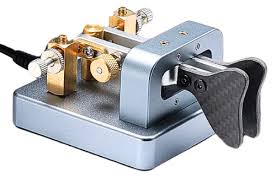
A beautiful piece of kit. Solid, well-adjusted, and satisfying to use. An iambic paddle has two levers: one for dits, one for dahs. Squeeze both together and it alternates automatically — dit-dah-dit-dah — which is what makes iambic keying efficient at speed. Just holding it and making sounds already feels like learning something real.
TopBytes Morse Trainer v2
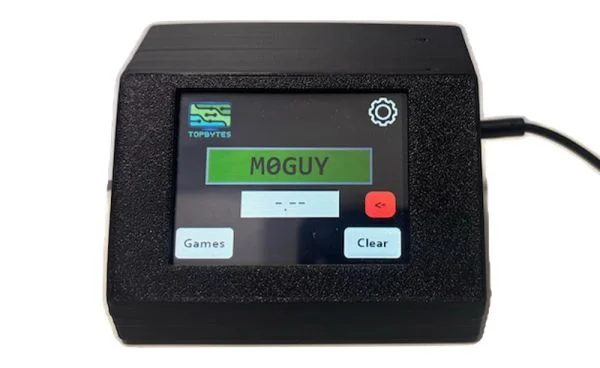
This one was an unexpected hit. The TopBytes trainer is a standalone device with a small display that shows what you are keying, includes practice modes and games, and gives instant visual feedback on what you are sending. No computer needed.
I expected to use it occasionally. Instead, I find myself picking it up constantly — and so do my kids. Turns out Morse code games are genuinely fun. If this is what it takes to get the next generation interested in amateur radio, I am not complaining.
Where I Am Now
Early days. My character recognition on LCWO is still slow and my hands are even slower. But I can already feel the difference between counting and hearing — and I am chasing that feeling.
If you have been through this process yourself — what worked, what did not, what you wish you had known earlier — please get in touch. I could use all the experienced guidance I can get.
73, Kristof — ON3VZ