On March 28, 2026, my club ON6WL organises an ARDF training and test day, a perfect opportunity to discover a discipline I had never tried before. The day revolves around an extensive field test of the WLD ARDF NextGen system, which will make me leave with a head full of new knowledge and a real appetite for more.
What is ARDF?
ARDF stands for Amateur Radio Direction Finding, often called fox hunting. The idea is simple but surprisingly deep: a number of low-power transmitters (the “foxes”) are hidden across a terrain. Participants carry a directional receiver and use the signal strength and bearing to track down as many foxes as possible within a set time. It combines orienteering, navigation skill, and radio technique in one activity.
ARDF is an officially recognised sport with its own IARU competition rules. Events typically run on the 80 m (3.5 MHz) or 2 m (144 MHz) band, with each fox transmitting in turn so hunters can take bearings from multiple positions.
The WLD ARDF NextGen System
The WLD ARDF NextGen is a modern, open-source transmitter platform designed specifically for ARDF events. It improves on older fox hardware in several ways:
- Precise timing and synchronisation between multiple transmitters via GPS or network
- Configurable output power and call sign — easy to set up for different band plans
- Compact and weatherproof — ready for field deployment
- Telemetry feedback — organisers can monitor transmitter status remotely
The test day is about putting this system through its paces under realistic conditions: checking timing accuracy, signal quality, and ease of deployment for a full club event.
New to Me — and Immediately Fascinating
I’ll be honest: before this day, ARDF was just a name to me. I had seen it mentioned in amateur radio magazines but never really understood what it involved. The first time I picked up a directional antenna and tried to make sense of a signal bouncing off trees and buildings, I felt completely lost.
But that confusion didn’t last long. Once the logic clicks, turn until the signal fades, walk, take another bearing, repeat, something changes. You start to feel the radio. The combination of physical movement, landscape reading, and RF technique is genuinely addictive. Sport and radio amateur practice in one activity: I hadn’t expected that, and I find it fascinating.
Hands-On Workshop: Tuning the Fox Antennas
Alongside the field test, there was a technical workshop I found equally rewarding. We got to help tune the antennas of the fox transmitters, making sure each one was properly resonant on the target frequency.
This was my first real hands-on time with an antenna analyser (a RigExpert AA-170), and it was eye-opening.
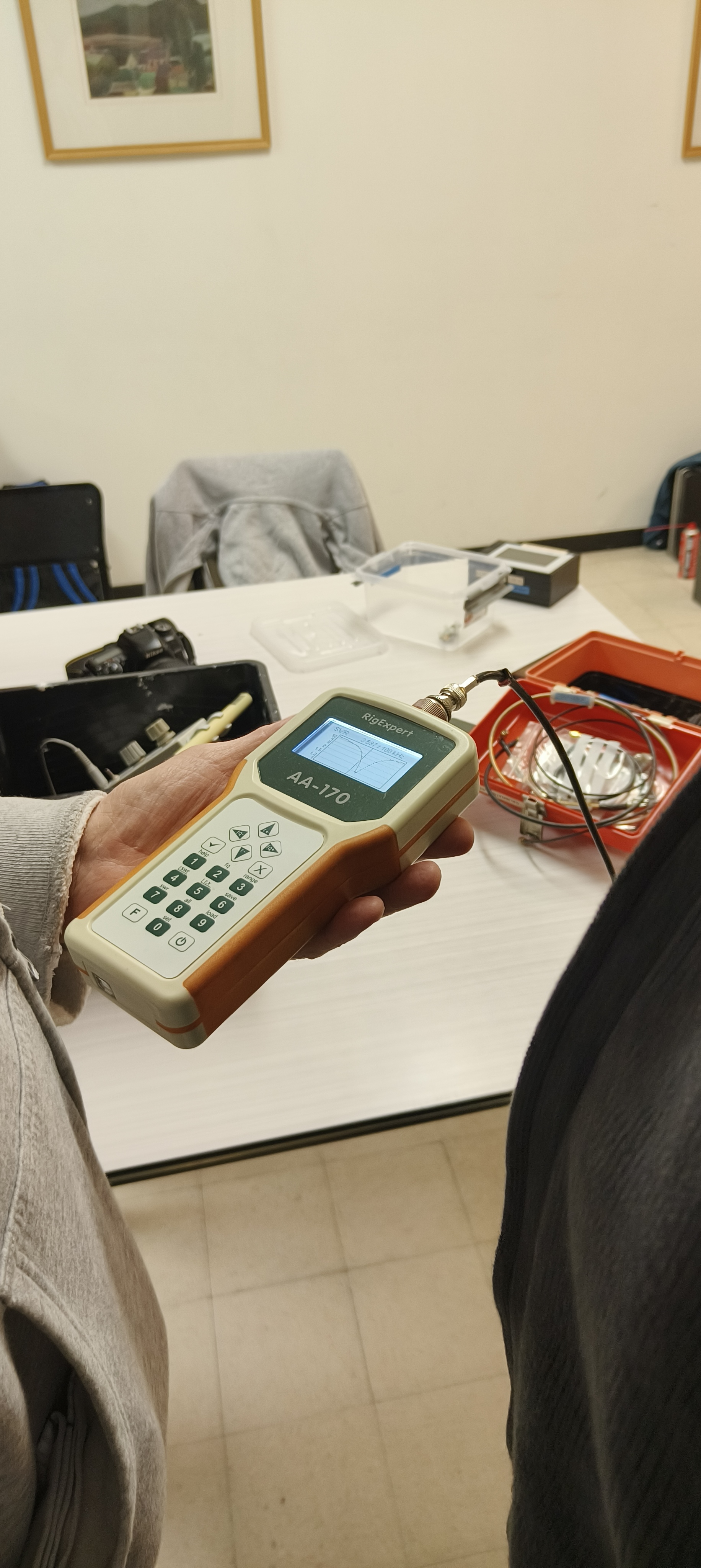
We worked through the key concepts step by step:
- Radials and their effect: adding or removing radials changes the ground plane and shifts the resonant frequency noticeably
- Reflection and SWR: understanding why a mismatch sends power back towards the transmitter, and how to read that on the analyser
- Fine-tuning antenna length: trimming or extending the radiating element to bring the SWR down to an acceptable level, ideally below 1.5:1
Watching the SWR curve shift in real time as you clip a few millimetres off the antenna wire is one of those moments where theory and practice suddenly connect.
The Real Value: the People
Beyond the equipment and the sport, the biggest takeaway from this day is the knowledge shared by experienced club members. Decades of practical antenna work distilled into tips, war stories, and patient explanations, the kind of thing you simply cannot get from a book or a YouTube video.
If you are anywhere near ARDF or are curious about direction finding, I strongly recommend getting in touch. This will be an excellent introduction, and it definitely won’t be my last fox hunt.
73, Kristof — ON3VZ