By ON3VZ / Kristof, Hoboken (Antwerp), Grid JO21EE Member of UBA and radio amateur club WLD (ON6WL)
Now that my first HF QSOs are starting to work (you can follow them in my logbook), a new question popped up: what about QSL cards? I already received my first electronic confirmation from a station in Canada, and that felt great. But there is something special about a real paper card landing in your mailbox. So I had my own ON3VZ cards printed, and then thought: now what? As a member of the WLD section of the UBA I started gathering the information I needed. This post is that information, bundled, translated and laid out so the next newcomer does not have to start from scratch.
I already wrote a broad logging and QSL guide that covers the digital side (LoTW, eQSL, Clublog, QRZ.com) in depth. This post is the focused companion to it: everything about paper cards through the UBA bureau, the cheapest way to exchange real QSLs, updated for the 2026 reorganisation.
🇧🇪 Written for the Belgian situation. The bureau described here is the one run by the UBA (the Royal Union of Belgian Radio Amateurs), so the sections, the national QSL manager and the sort list are all Belgian specifics. The general ideas (how to fill out a card, sorting by IARU bureau, the “QSL via” rules) apply anywhere, but the procedure, the addresses and the resources below are UBA’s. If you are licensed in another country, your own national society runs an equivalent bureau.
On This Page
- What a QSL card is, and the three ways to exchange one
- May you use the bureau?
- How to fill out a card
- The scenarios: what does “QSL VIA” mean?
- The journey of your card
- Sorting, step by step
- Using the sort list V1.0
- Countries without an IARU bureau
- Receiving cards
- Checklist for your first batch
- What changed in 2026
- A few things I learned along the way
- Useful resources
1. What a QSL Card Is, and the Three Ways to Exchange One
A QSL card is the written confirmation of a radio contact (a QSO). The code “QSL” comes from the international Q-code and means “I confirm receipt”. In practice it is a kind of postcard that proves, in black and white, that two stations actually worked (or heard) each other. It has been called the “final courtesy of a QSO” since the earliest days of radio: you send your card, the other station sends one back, and only when both have been exchanged is the contact fully confirmed.
What is it good for? As a keepsake and lasting proof of a special contact, as evidence for awards such as DXCC, WAC, WAS and the UBA diplomas, and for SWL listeners (ONL) as confirmation of a reception report.
There are roughly three ways to exchange QSLs:
| Channel | Speed | Cost | Notes |
|---|---|---|---|
| Via the bureau | Slow (months, sometimes over a year) | Included in your UBA membership | The cheapest paper route. This is what this post is about. |
| Direct | Fast (weeks) | Postage, roughly €1 to €3 per card | By post to the other station, with return postage. |
| Electronic | Minutes to days | Free or subscription | LoTW, eQSL, QRZ.com, Club Log. No paper, but counts for most awards (see my digital guide). |
💡 In short: the UBA bureau is by far the cheapest way to send paper cards. You pay nothing extra: the cost sits in your UBA membership. The trade-off is patience. Reckon on months, sometimes more than a year, before a reply card comes back.
2. May You Use the Bureau?
The QSL service is a member service. To use it, a few simple conditions apply:
- You are a UBA member affiliated with a section. For me that is WLD (ON6WL). You hand in your cards at, and receive them through, that section.
- The cost of the service is paid from a part of your membership fee, so you pay nothing per card.
- Make sure the membership administration has your correct details (callsign, address, email). Something changed? Report it via members@uba.be.
- If you ever operate under a holiday, expedition or foreign callsign, that callsign must be registered separately with the membership administration (with a copy of the licence if it concerns a non-CEPT country). Otherwise incoming cards for that call cannot reach you.
⚠️ Heads up: non-members cannot use the bureau. Hand in only your own cards, and never pass cards from a non-member through the section, as those are refused.
3. How to Fill Out a Card
Every card needs the details of the QSO. Without them the other station cannot find your contact in their log, and the card is worthless. Here is what belongs on a card, and the layout rules that keep the sorter happy.
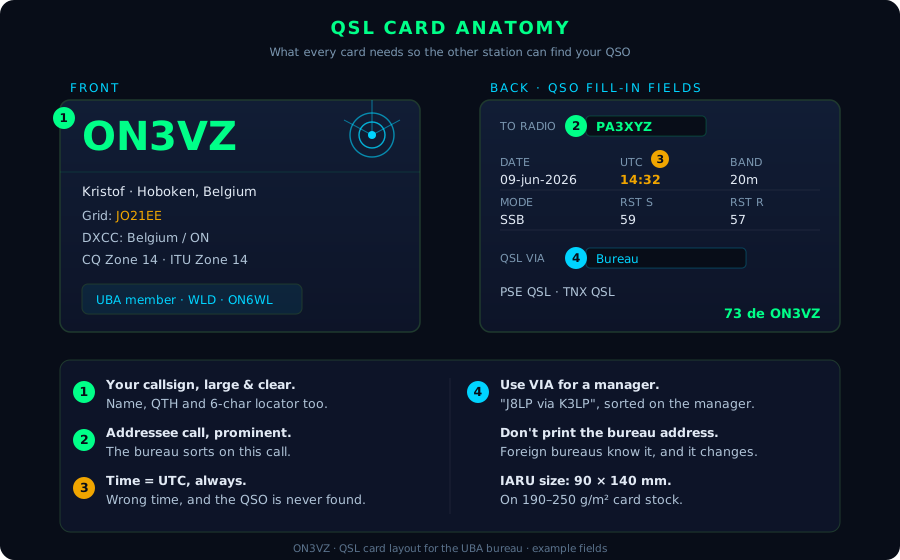
The mandatory fields
| Field | Note |
|---|---|
| Counterpart callsign | Who the card is addressed to. Place it prominently. |
| Date | The date of the QSO, written unambiguously (e.g. 09-jun-2026). |
| Time in UTC | Always UTC, never local time. This is the most common beginner mistake. |
| Band or frequency | For example 20 m or 14.074 MHz. |
| Mode | SSB, CW, FT8, RTTY, and so on. |
| RST report | The signal report you gave (e.g. 59 or 599). |
| PSE / TNX QSL | “PSE QSL” asks for a card back, “TNX QSL” thanks for one received. |
| Your own details | Your callsign (ON3VZ), name, QTH and locator (JO21EE), optionally rig, antenna and power. |
Layout rules for the bureau
Do this, it makes the sorter’s work easy: put the addressee’s callsign clearly and large (that is what gets sorted), keep the card tidy and readable, and use the word “VIA” when the card needs to go to a QSL manager (see section 4).
Avoid this, it causes errors or delay: never print the address of the UBA bureau on your card (the foreign bureaus already know it, and it can change), never place two callsigns right next to or under each other without making clear who the card is for (an ONL card usually carries two calls), and avoid tiny or sloppy text that the sorter has to decipher with a magnifying glass.
Form, size and weight
Stick to the IARU standard size: 90 × 140 mm, on 190 to 250 g/m² card stock. That makes sorting and bundling smoother.
🥇 Golden tip for newcomers: note the time in UTC, not local time. If you write “21:00” meaning 21:00 Belgian time, the other station will not find your QSO (in their log it sits at 19:00 or 20:00 UTC). One wrong time equals no confirmation.
4. The Scenarios: What Does “QSL VIA” Mean?
Not every card goes straight to the other station. Here are the situations you will meet as a beginner, and what to do each time.
| Situation | What it means | What you do |
|---|---|---|
| You operate from abroad (e.g. F/ON3VZ) | Cards for your holiday or foreign call belong to you at home. | Nothing special: they come back to you via the bureau. No “via” needed. |
| Counterpart has a QSL manager (e.g. J8LP via K3LP) | The DX station has someone else handle their cards. | Write “J8LP via K3LP” and sort on the manager’s bureau (here the USA). Never “c/o”, and never reversed (“K3LP via J8LP”). |
| Belgian station via Belgian station (ON4yyy via ON4xxx) | A Belgian amateur routes their cards via another Belgian. | Allowed only if both are UBA members. |
| You manage a foreign call (e.g. 5X1T via ON3VZ) | You want to receive cards for a non-Belgian call. | That call must be registered with the membership administration (with a licence copy), or you provide proof it is the same person. |
| DX without a bureau, no manager | There is no IARU bureau in the other station’s country. | Always ask “QSL via?” during the QSO. No manager? Then send direct to the given address (often a P.O. Box). |
📌 Remember about “VIA”: always use the word VIA to indicate where the card should go, and decide the bureau based on the manager, not the DX station. So “J8LP via K3LP” goes to the bureau of the USA (K = USA).
5. The Journey of Your Card
Once you hand your cards in, they follow a fixed route. Since the 2026 reorganisation it looks like this.
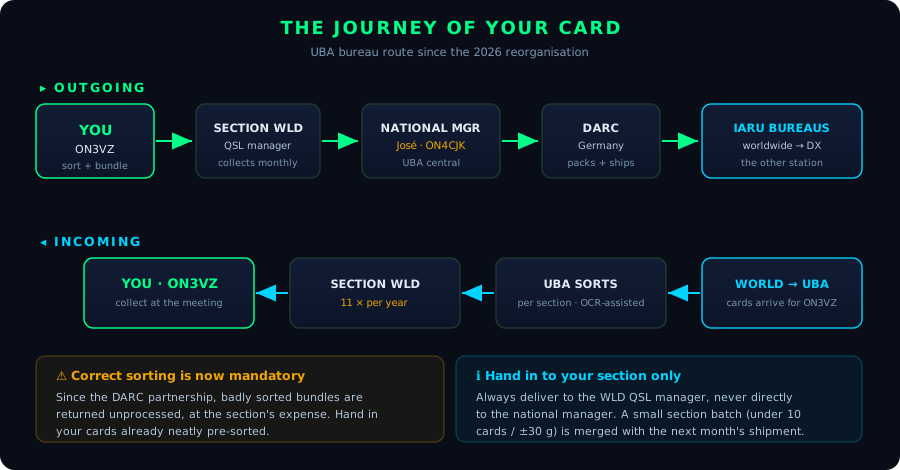
Outgoing. You hand your sorted cards to the QSL manager of your section (WLD). Never hand in directly to the national QSL manager, that is not allowed. The section collects the cards, checks the sorting, and forwards everything monthly to the national QSL manager, José (ON4CJK). He sends the correctly sorted packets to the German sister society DARC, which packs everything and ships it worldwide to the IARU bureaus.
Incoming. International cards are, for now, sorted within the UBA itself per section and go 11 times per year to the local managers, and so to you. If a section has fewer than 10 cards ready (about 30 g), that shipment is merged with the next month’s.
⚠️ Important change since 2026: because of the new cooperation with DARC, correct sorting is now mandatory. Where an eye was sometimes turned in the past, poorly sorted packets are now returned unprocessed, at the section’s expense. All the more reason to hand in your cards neatly pre-sorted.
6. Sorting, Step by Step
Whoever hands in cards must sort them beforehand. That saves your section manager an enormous amount of work and stops a shipment from being refused.
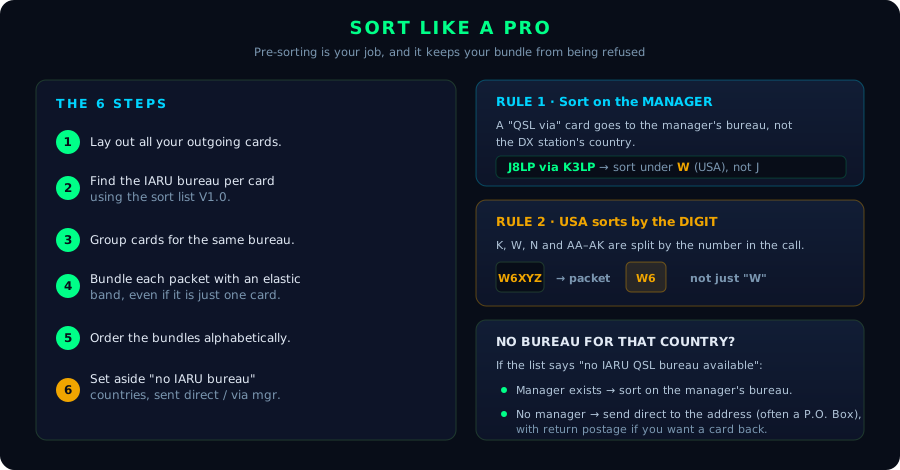
- Lay out all your outgoing cards on the table.
- Determine the correct IARU QSL bureau for each card with the sort list V1.0 (see section 7).
- Group all cards for the same bureau together.
- Bundle each country packet with an elastic band, even if it is just one card.
- Lay the bundles in alphabetical order of the bureau code.
- Keep aside the cards for countries marked “no IARU QSL bureau available”, those cannot go via the bureau (see section 8).
7. Using the Sort List V1.0
The UBA provides two tools for looking up the correct bureau:
- QBuS (QSL Bureau Search) at qbus.uba.be: the official online lookup by Rik ON7YD. Enter any callsign or prefix and it tells you the correct IARU bureau and whether one exists at all. Free, no login needed.
- Sort list V1.0 PDF: the printable reference, available for UBA members in the UBA Downloads area (login required). It has three columns: the prefix (e.g. DL, G, W, ON), the country or region, and the packet (the bureau code to sort under).
A few worked examples:
- You worked DL1ABC (Germany). Prefix “DA to DR” goes in packet DL.
- You worked G3XYZ (UK). Prefix “G” goes in packet G.
- You worked an ON station. Prefix “ON to OT” goes in packet ON (domestic).
🇺🇸 Special case, the United States: American calls (K, W, N and AA to AK) are sorted by the digit in the callsign (W1 through W0). So W6XYZ goes in packet W6, not simply in “W”.
Common destinations (excerpt)
A handful of bureaus you will meet most often as a beginner. When in doubt, always confirm with QBuS.
| Prefix | Country / region | Packet |
|---|---|---|
| ON – OT | Belgium | ON |
| PA – PI | Netherlands | PA |
| DA – DR | Germany | DL |
| F, FA – FJ | France | F |
| G – GZ, M, 2A – 2Z | United Kingdom | G |
| I, IA – IZ | Italy | I |
| EA – EH | Spain (incl. islands) | EA |
| CT, CU | Portugal / Azores | CT |
| OE | Austria | OE |
| HB9 / HB / HE | Switzerland | HB9 |
| OZ, 5P – 5Q, OX | Denmark / Greenland | OZ |
| LA – LN, JW, JX | Norway / Svalbard | LA |
| SA – SM, 7S, 8S | Sweden | SM |
| OF – OJ | Finland | OH |
| SP, SN – SR, 3Z | Poland | SP |
| K / W / N / AA – AK | United States | By digit: W1 – W0 |
| VA – VG, VE, VO, VY | Canada | VE |
| JA – JS, 7J – 7N | Japan | JA |
| VK, VH – VN, AX | Australia | VK |
| PP – PY | Brazil | PY |
💡 Exotic prefix you don’t recognise? QBuS will handle it. Also cross-check with the IARU list of QSL bureaus to confirm the bureau is still active.
8. Countries Without an IARU Bureau
Not every country has a working QSL bureau. If a prefix is marked “no IARU QSL bureau available”, you cannot send that card via the bureau. You then have two options:
- Is there a QSL manager (asked with “QSL via?” during the QSO)? Then sort the card on the manager’s bureau.
- Is there no manager? Then send the card direct to the given address, with return postage if you want a card back.
🧭 A good DX-er always keeps the little list of countries without a bureau at hand. The sort list V1.0 indicates this for every prefix.
9. Receiving Cards
The other direction works by itself, as long as your details are correct. Incoming cards are delivered to you 11 times per year via your section, usually at the monthly section meeting. The sorting system works on the basis of the membership database, so if your callsign is not in there (correctly), you cannot receive cards. Keep your details current via members@uba.be.
10. Checklist for Your First Batch
Run through this list before you hand your cards in:
- I am a UBA member and affiliated with my section (WLD / ON6WL).
- My callsign (and any extra calls) is correct in the membership administration.
- Every card carries: counterpart call, date, UTC time, band, mode and RST report.
- The addressee’s callsign is prominent, and the bureau address is not on the card.
- “VIA manager” is correctly noted where needed (and sorted on the right bureau).
- All cards are sorted per IARU bureau with the sort list V1.0.
- The country packets are bundled with an elastic band and ordered alphabetically.
- Cards for countries without a bureau are kept aside (direct or via manager).
- I hand everything to the QSL manager of my section, not directly to the national manager.
11. What Changed in 2026
In CQ-QSO 05-06/2026 the board explained a thorough reorganisation of the QSL service. In short:
- The Dutch sheltered workshop Scalabor, which sorted and packed the cards for years (also for VERON), stopped that task after an internal restructuring, a retirement and a relocation.
- Outgoing cards now run via the national QSL manager José (ON4CJK) to the DARC, which takes over the packing and worldwide shipping.
- Incoming cards are, for now, sorted within the UBA itself per section, with a new self-built system that already uses optical callsign recognition.
- For the individual member little changes in practice, except that correct sorting is now strictly enforced.
ℹ️ The service therefore simply continues for all 3,000-plus members. Rumours of a phase-out are unfounded.
12. A Few Things I Learned Along the Way
These are not in my source bundle, but they are the lessons that saved me effort. Treat them as a fellow newcomer’s notes, not gospel:
- Check the QSL policy before you send a bureau card. Look the station up on QRZ.com. Many DX stations and DXpeditions are “LoTW only” or “direct / OQRS only”, and a bureau card to them is wasted effort. If someone says “no QSL needed, LoTW only”, respect it.
- The bureau is slow on purpose, so match the tool to the goal. For an everyday European contact, the bureau is perfect. For a new DXCC entity you are proud of and want quickly, direct mail or Club Log OQRS is faster.
- A bureau card still needs both halves. You send yours, they send theirs. If the other side does not work the bureau, your card may never be answered. That is not rudeness, just a different workflow.
- Paper and digital are not rivals. I log everything digitally (LoTW and eQSL) for the awards, and send paper through the bureau for the ones I want on the wall. The two tracks live happily side by side.
13. Useful Resources
| Resource | Link |
|---|---|
| UBA QSL service (EN) | uba.be/en/node/2007 |
| QBuS: bureau lookup tool | qbus.uba.be |
| Sort list V1.0 PDF (members) | UBA Downloads |
| IARU list of active QSL bureaus | iaru.org/reference/qsl-bureau-2 |
| Changes to your details | members@uba.be |
| My digital companion guide | From First QSO to First QSL Card |
That is the state of my QSL knowledge today: a bundle of official UBA guidance, the IARU bureau list and the May-June 2026 CQ-QSO article, laid out the way I wish I had found it. My own ON3VZ cards are printed and waiting, my first batch is being sorted, and somewhere a card from Canada is sitting on my desk reminding me why this old paper tradition is still worth the wait.
If you spot something I have wrong, or a scenario I have missed, do let me know. This grows with experience.
73 de ON3VZ, Kristof, still sorting cards one prefix at a time. Hoboken (Antwerp), Grid JO21EE, UBA / WLD / ON6WL